
The Nome Serum Run
On This Day in History: February 2

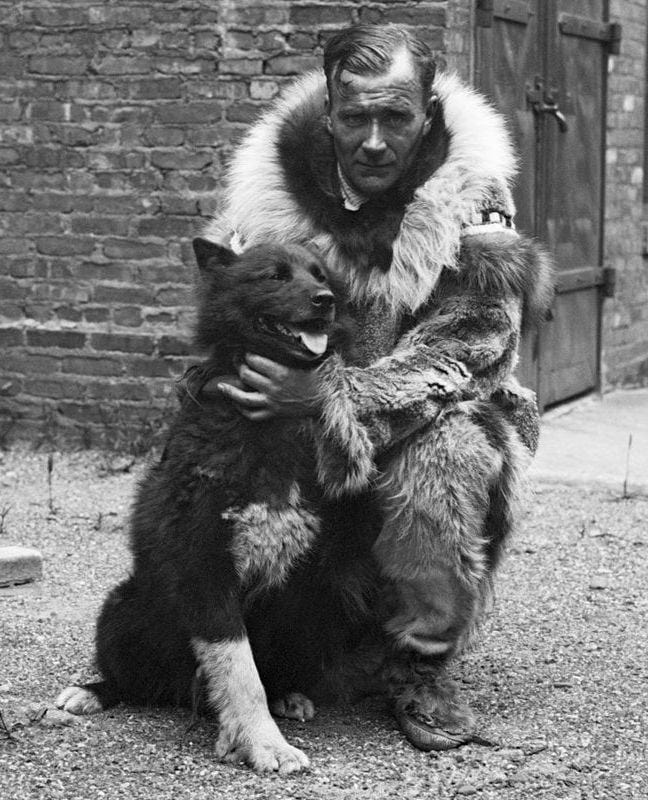
See this fuzzy boy? His name was Balto and he was a Siberian Husky who led a team of sled dogs through horrific winter conditions into the remote town of Nome, Alaska, carrying life-saving medicine to halt a diphtheria outbreak in what became known as the 1925 Serum Run.
--On This Day in History Shit Went Down: February 2, 1925--
I’m Canadian and have done 10-kilometer (6.2 mile) runs in –30° Celsius (–22° Fahrenheit). It’s cold as fuck and frosts up the eyelashes so you can’t see for shit. For this tale it was –46°C (–50°F), because it was way the hell north at the edge of the Arctic Circle and the temperatures were at a twenty-year low. Add in brutal winds, deep snow, and nonexistent visibility and you really just want to stay home and drink whiskey.
But in 1925 children were dying, the disease spreading.
The outbreak of the bacterial infection began in January, and the small town’s sole doctor sent a desperate telegram calling for aid. Diphtheria is a toxin, and a life-saving antitoxin was needed. The nearest place that had serum that could halt the outbreak was located in Anchorage, but the engine on the only airplane that could fly it to Nome was frozen solid. Officials brainstormed and decided to send the serum north to the city of Nenana via train, where relays of mushers driving sled-dog teams would take it 674 frozen-as-fuck miles west to Nome.
One hundred and fifty dogs participated in the relay. Some of them died so children could live. Of more than twenty mushers, most of them Alaskan Natives, several suffered frostbite. The trip was made in a record-breaking five and a half days.
Norwegian musher Gunnar Kaasen and his Balto-led team made the final leg of the perilous journey. He was supposed to be the penultimate musher, but when he arrived at Point Safety at 2:00 A.M. he discovered his replacement was asleep, so he pressed on an additional twenty-five miles to Nome, arriving at 5:30 in the morning on February 2, 1925.
The serum was thawed and administered, and there were no further deaths. Kaasen and Balto became heroes. There is even a statue of Balto, who lived to be fourteen, in New York’s Central Park. Balto was indeed a good boy, but his public status was achieved via being the one to lead the final leg. The best boy on the perilous journey was Togo. Balto traveled fifty-five miles, but Togo, also a Siberian Husky, led a team for almost five times that distance. He ran a whopping 260 miles, almost 40 percent of the entire relay. And he was twelve years old!
Togo lived to be sixteen and sired many puppies. One of his direct descendants, Diesel, starred as his multiple-great-grandfather in a 2019 film titled Togo, alongside bipedal actor Willem Dafoe. It’s an excellent movie. Have tissues ready.
NOTE: This piece was researched and written by a human, not some bullshit “ai” plagiarism software.
Those who cannot remember the past need a history teacher who says “fuck” a lot. Get both volumes of ON THIS DAY IN HISTORY SH!T WENT DOWN.

There was an episode of a show called The Secrets of Central Park. The ranger said Balto’s is the ONLY statue that never needs polishing because of kids constantly climbing on him.
What an amazing story. Thank God for dogs, and humans that care for them. Thanks.